> For the complete documentation index, see [llms.txt](https://junnie.gitbook.io/nine-chapter/llms.txt). Markdown versions of documentation pages are available by appending `.md` to page URLs; this page is available as [Markdown](https://junnie.gitbook.io/nine-chapter/3.breadth-first-search/542.-01-matrix-m.md).
# 542. 01 Matrix (M)
Given an `m x n` binary matrix `mat`, return *the distance of the nearest* `0` *for each cell*.
The distance between two adjacent cells is `1`.
**Example 1:**
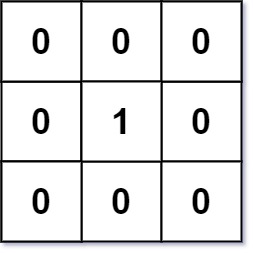
```
Input: mat = [[0,0,0],[0,1,0],[0,0,0]]
Output: [[0,0,0],[0,1,0],[0,0,0]]
```
**Example 2:**
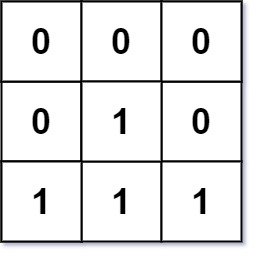
```
Input: mat = [[0,0,0],[0,1,0],[1,1,1]]
Output: [[0,0,0],[0,1,0],[1,2,1]]
```
**Constraints:**
* `m == mat.length`
* `n == mat[i].length`
* `1 <= m, n <= 104`
* `1 <= m * n <= 104`
* `mat[i][j]` is either `0` or `1`.
* There is at least one `0` in `mat`.
### Solution:
**Version 1: BFS**
先把所有的0 进queue, 再一个一个pop
```
class Solution {
private int[][] result;
public int[][] updateMatrix(int[][] mat) {
int m = mat.length;
int n = mat[0].length;
int[][] result = new int[m][n];
boolean[][] visited = new boolean[m][n];
Queue queue = new LinkedList();
int[] dx = new int[]{-1,1,0,0};
int[] dy = new int[]{0,0,-1,1};
for(int i = 0; i< m; i++)
{
for(int j = 0; j< n; j++)
{
if(mat[i][j] == 0)
{
visited[i][j] = true;
queue.offer(new Node(i,j));
result[i][j] = 0;
}else
{
result[i][j] = Integer.MAX_VALUE;
}
}
}
while(! queue.isEmpty())
{
int size = queue.size();
for(int i = 0;i< size;i++)
{
Node current = queue.poll();
for(int k = 0; k< 4; k++)
{
int directX = current.x + dx[k];
int directY = current.y + dy[k];
if(isBound(mat, directX, directY) && !visited[directX][directY])
{
queue.offer(new Node(directX, directY));
visited[directX][directY] = true;
result[directX][directY] = Math.min(result[directX][directY], result[current.x][current.y] + 1);
}
}
}
}
return result;
}
public boolean isBound(int[][] mat, int x, int y)
{
int m = mat.length;
int n = mat[0].length;
return x>=0 & x=0 && y 0) dp[i][j] = Math.min(dp[i][j], dp[i - 1][j] + 1);
if (j > 0) dp[i][j] = Math.min(dp[i][j], dp[i][j - 1] + 1);
}
}
for (int i = n - 1; i >= 0; --i) {
for (int j = m - 1; j >= 0; --j) {
if (dp[i][j] > 0) {
if (i < n - 1) dp[i][j] = Math.min(dp[i][j], dp[i + 1][j] + 1);
if (j < m - 1) dp[i][j] = Math.min(dp[i][j], dp[i][j + 1] + 1);
}
}
}
return dp;
}
}
```
test case:
Input: \[\[1,0,1,1,0,0,1,0,0,1],\[0,1,1,0,1,0,1,0,1,1],\[0,0,1,0,1,0,0,1,0,0],\[1,0,1,0,1,1,1,1,1,1],\[0,1,0,1,1,0,0,0,0,1],\[0,0,1,0,1,1,1,0,1,0],\[0,1,0,1,0,1,0,0,1,1],\[1,0,0,0,1,1,1,1,0,1],\[1,1,1,1,1,1,1,0,1,0],\[1,1,1,1,0,1,0,0,1,1]]
Output: \[\[-2147483647,-2147483648,-2147483647,-2147483646,-2147483645,-2147483644,-2147483643,-2147483642,-2147483641,-2147483640],\[-2147483648,-2147483647,-2147483646,-2147483645,-2147483644,-2147483643,-2147483642,-2147483641,-2147483640,-2147483639],\[-2147483647,-2147483646,-2147483645,-2147483644,-2147483643,-2147483642,-2147483641,-2147483640,-2147483639,-2147483638],\[-2147483646,-2147483645,-2147483644,-2147483643,-2147483642,-2147483641,-2147483640,-2147483639,-2147483638,-2147483637],\[-2147483645,-2147483644,-2147483643,-2147483642,-2147483641,-2147483640,-2147483639,-2147483638,-2147483637,-2147483636],\[-2147483644,-2147483643,-2147483642,-2147483641,-2147483640,-2147483639,-2147483638,-2147483637,-2147483636,-2147483635],\[-2147483643,-2147483642,-2147483641,-2147483640,-2147483639,-2147483638,-2147483637,-2147483636,-2147483635,-2147483634],\[-2147483642,-2147483641,-2147483640,-2147483639,-2147483638,-2147483637,-2147483636,-2147483635,-2147483634,-2147483633],\[-2147483641,-2147483640,-2147483639,-2147483638,-2147483637,-2147483636,-2147483635,-2147483634,-2147483633,-2147483632],\[-2147483640,-2147483639,-2147483638,-2147483637,-2147483636,-2147483635,-2147483634,-2147483633,-2147483632,-2147483631]]
Expected: \[\[1,0,1,1,0,0,1,0,0,1],\[0,1,1,0,1,0,1,0,1,1],\[0,0,1,0,1,0,0,1,0,0],\[1,0,1,0,1,1,1,1,1,1],\[0,1,0,1,1,0,0,0,0,1],\[0,0,1,0,1,1,1,0,1,0],\[0,1,0,1,0,1,0,0,1,1],\[1,0,0,0,1,2,1,1,0,1],\[2,1,1,1,1,2,1,0,1,0],\[3,2,2,1,0,1,0,0,1,1]]